
Bergen Records Sources by Era
The backward trail changes with the date. Bergen's online land-record system starts in 1970, while older records require a different route through the County Clerk, archive collections, FamilySearch, historical societies, libraries, and maps. A source can show a party to an instrument, a printed listing, a landowner, or a street layout. It does not automatically show every past resident. Begin with the latest dated record that fits the question, then move to the earlier source type indicated by the coverage boundary.
| Source | Years It Covers | Where Held | What It Shows |
|---|---|---|---|
| Bergen Clerk land-record search | 1970-present online | Bergen County Clerk public land-record portal | Recorded instruments, parties, parcel references, and linked documents |
| County Clerk historical route | Older county records and historic maps | Registry/Land Records and related county holdings | Book and page leads, predecessor-owner references, and municipal context |
| NJ State Archives and FamilySearch | Deeds through 1900; mortgages 1766-1850 in described collections | State archive route and identified FamilySearch material | Earlier grantor-grantee chain with image or index boundaries |
| Bergen directory collections | 1879-2018/19, intermittent | Johnson Public Library, BCHS, and other repositories | Dated name and address clues, with geographic and format limits |
| Map and atlas leads | 1861; 1876; 1912/13; 1926-1950 examples | LOC record and collection routes | Landowners, roads, buildings, footprints, and street-layout context |
The FamilySearch Bergen records catalog is a useful archive route because its items include Bergen Bible, deed, marriage, and Reformed Dutch Church material with item-specific date spans. Check the catalog description and image availability for the exact record, rather than treating the catalog as a single complete address index.
The catalog can point an address-history search toward older record groups, but each item must be checked for its own coverage and access condition.
Bergen Records and the 1970 Boundary
Bergen's public land-record search identifies deeds and mortgages recorded from January 1, 1970 through the present. Its BrowserView interface offers search families for case or parcel, instrument number, book and page, party name, legal description, and parcel-related fields. A result can show multiple lines for one instrument because parties are indexed separately. Search spelling variants and read the linked document or image where available instead of relying only on an index line.
The New Jersey State Archives genealogical collections identify the earlier route: county deeds through 1900 are described as microfilmed and digitized through FamilySearch, and county mortgages from 1766-1850 are another collection path. The coverage statements mark an access route, not an assurance that each book, image, or name is online.
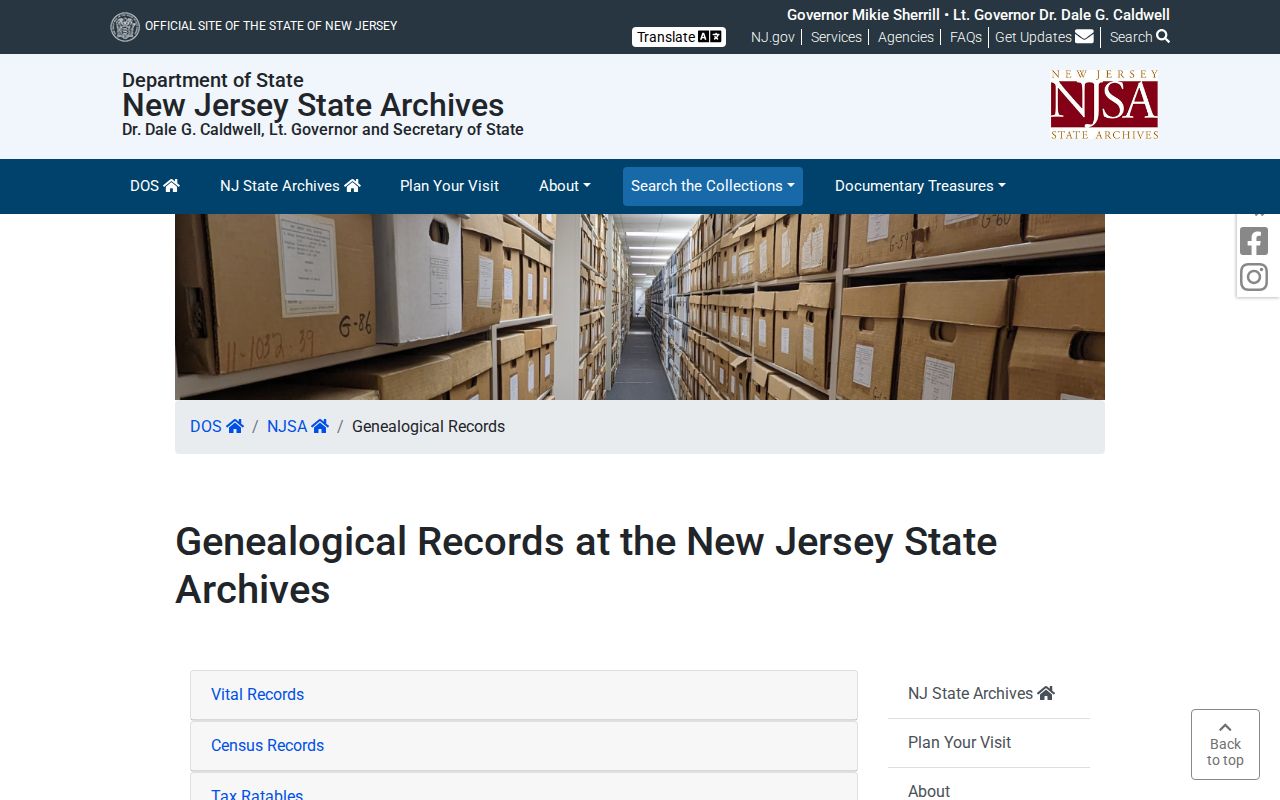
The State Archives route is the documented next stop once a Bergen deed trail passes the online portal's 1970 starting point.
In-person public viewing and copying are available through the Bergen County Clerk Registry/Land Records office, Monday through Friday from 8:30 a.m. to 4:30 p.m. The office is at One Bergen County Plaza, Hackensack. The published Registry/Land Records number is 201-336-7036, while the County Clerk general office is 201-336-7000. Staff can assist with access, but the Land Records Services page says they cannot perform the search for a requester. Note: The online cutoff is an access boundary, not a claim that county property history began in 1970.
Follow Bergen Deed Records Backward
Use the parcel and deed trail to identify transfer parties, not to assume occupancy. First resolve the present municipality, street number, block, and lot through the county-linked property route or the municipal assessor. The county guidance supports searching by owner, property location or address, municipality, block, and lot, but current field labels and historical coverage require live verification. A parcel identifier is the steadier bridge when an address or municipality name has changed.
- Record the current municipality, street line, block, lot, and any parcel identifier before starting the index.
- Use the Clerk portal to search the known party, parcel, instrument, book and page, or legal description that matches the transaction.
- Open the document image when available and record the instrument date, party roles, municipality, consideration, and prior book or page references.
- Find the earlier transaction in which the prior party appears as a grantee, checking every plausible spelling and linked document.
- Repeat the documented link backward. Once the trail reaches pre-1970 material, shift to the Clerk's historical route, State Archives, FamilySearch, BCHS, or relevant maps.
- Grantor and grantee
- The grantor transfers an interest in the instrument. The grantee receives that interest. Party roles must be read from the actual record.
- Chain of title
- A dated sequence of transfers tied together through prior references and the same property identity. An index line alone does not complete the chain.
- Legal description
- The parcel language, lot and block, map reference, or other property description in a record. It can be more stable than a changing street line.
Bergen Address Records Need Separation
Keep legal municipality, mailing city, street name or number, and parcel identity separate. A mailing city can differ from the legal municipality. A historic street line can carry an old spelling, route description, or number. The parcel's block, lot, or parcel identifier may remain the most useful bridge even when the mailing form changes. This distinction prevents a searcher from silently merging two different records into one address history.
Bergen's municipal history gives concrete reasons to search more than one place name. Norwood formed from Harrington Township in 1905. Wallington was created in 1895 and later ceded sections to Garfield. Lyndhurst was previously Union Township, and Ridgewood's 1894 incorporation was followed by annexations. These are search terms and boundary clues. They do not establish that a particular household moved or that a parcel was affected by a specific change.
Note: No countywide official street-renaming or house-number-change index was located, so preserve the old wording rather than guessing a modern equivalent.
Bergen Map Clues Before Directory Searches
The 1861 Library of Congress Bergen map is a rare bridge source. It shows landowners' names, roads, buildings, householders, a Hackensack inset, and three city business directories. Use it to generate an older spelling, nearby landowner name, or road form. Then test that lead in deeds, directory years, and municipal-history material. The map supplies a dated landscape, not proof that a person stayed at a property across later years.
The Library of Congress Hackensack Sanborn record describes Sanborn Map Company volume 2, dated 1926 through September 1950, with 56 sheets for places including Hackensack, Teaneck, and Bogota. The bibliographic record has no online image. A Bergen County Historical Society publication reports Princeton digitized many Bergen Sanborn maps, but a current Princeton index or image link was not verified. Request a library or Princeton copy before promising a scan.
Old maps and atlases can show footprints, street layout, buildings, or landowner context. They cannot by themselves identify all past occupants at an address.
Pair Bergen Directories With Household Records
Ownership is only one part of an address history. A dated directory can add a printed name and street line, while another household source may supply a separate confirmation or conflict. Johnson Public Library's Hackensack runs, BCHS telephone books, historical newspapers, and the relevant census record each have their own date and scope. The detailed shelves and directory formats are collected on the Bergen city directory page.
Process: dated directory line → exact spelling and street wording → next available directory year → relevant census or newspaper check → deed or map comparison → dated research note. Do not turn a gap between steps into an occupancy claim.
FamilySearch's New Jersey county-marriage index can help test a family-history lead, but Bergen coverage is uneven: 1795-1878, 1905-1907, and 1913-1914 are identified within the wider 1682-1956 collection. Check an image when available. A marriage-index hit supplies an event lead, not a street address.
An indexed event can help distinguish similarly named people in a historical trail when its date and image support the connection.
Bergen Directory Requests Beyond the County
The Library of Congress address-directory guide records Bergen County North and South regional runs with gaps and lists specific Hackensack holdings. Its request advice is direct: state the directory type, state and locality, and exact year. That detail reduces false negative results from a broad county or city request. The guide's gaps must remain part of the research note.
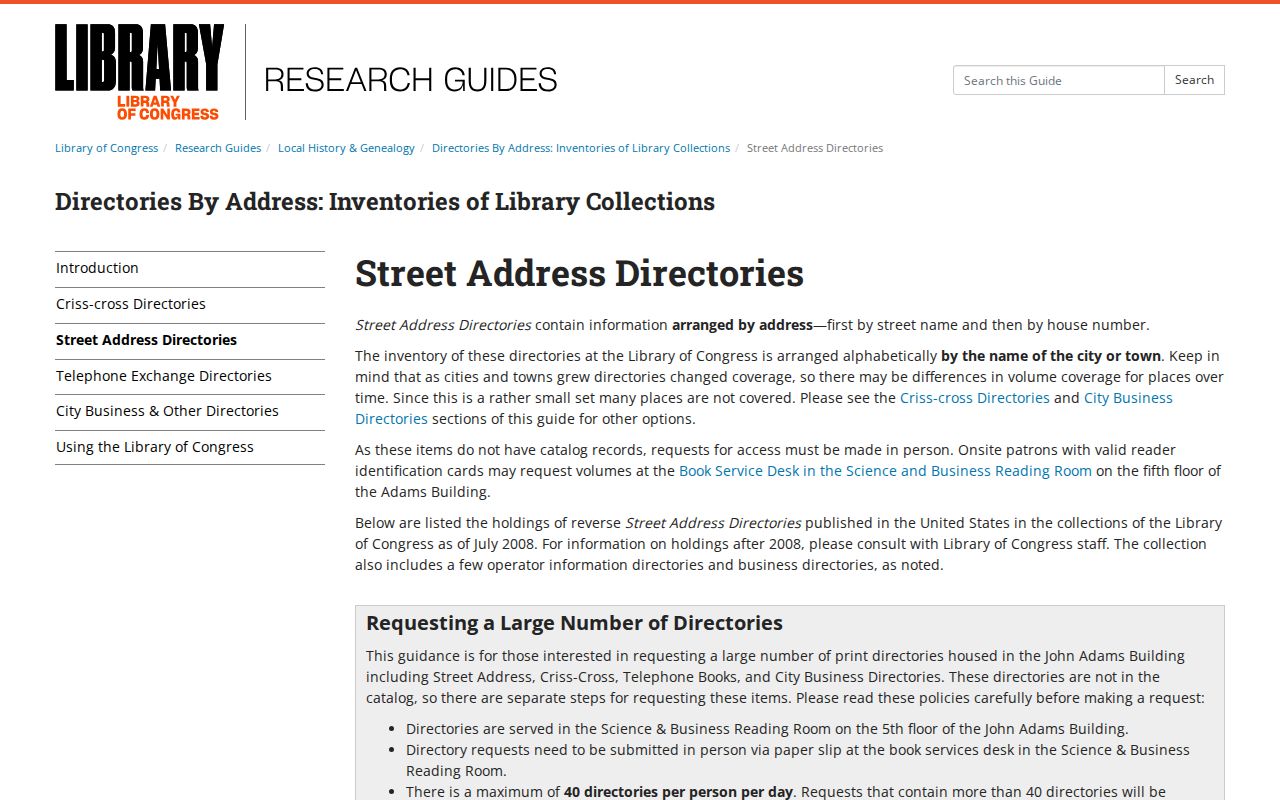
A precise request can locate the right shelf or reveal a genuine holdings gap without inventing a missing directory year.
Historical News Archive results, cemetery records, church material, and obituaries can extend the trail after a directory or deed reference. Record what the secondary item actually says and verify a decisive date or relationship with the appropriate record custodian.
Lawful Personal Use for Bergen Address History
Past-resident research is suited to family history, heir research, property-history context, and personal curiosity. Treat protected or redacted information as unavailable. New Jersey's Address Confidentiality Program provides eligible participants a legal substitute address, and Daniel's Law limits disclosure or removal of protected officials' home-address information. Neither program is an invitation to seek a confidential location through another source.
Lawful use. Use historical records only for lawful personal research. Do not use a name, address, or record trail to track, threaten, intimidate, or harass a living person.
Bergen records also change meaning with time. A deed party may not be a resident, a directory line may be stale, and a map may show land rather than a household. Preserve the source date, record role, municipality, and access limit with every finding. If two sources conflict, keep both citations and describe the difference rather than selecting the result that seems easiest to fit. That practice matters when a predecessor municipality, an old street form, or a gap in the online record creates an apparent break. A clear chronology can show what is known, what remains a lead, and where the next archive request belongs.