
Bergen Neighbors: Block Record Coverage
Block research works best when the evidence is labeled by purpose. Parcel data gives spatial context. A deed index gives party and instrument context. An election source is date-specific. Civic notices can identify public organization names, but they do not create a private roster. The sources below help distinguish a block record from a claim about who is present today.
| Source | What It Shows About a Block | Access |
|---|---|---|
| County property route | Municipality, address, block and lot, plus assessment context after field verification | County-linked public route |
| Bergen Clerk land records | Instrument parties, parcel, legal description, and recording dates | Online records from 1970 forward; older research has other channels |
| County GIS or NJGIN | Parcel geometry, roads, and layer context | Public spatial-data context; owner names can be redacted |
| Election records | Registration or list context at a stated date | State route or Bergen written request |
| Historic map or directory | Past landowner, road, building, or listing context | Library, archive, or map collection |
None of these sources proves that every person at a nearby address is a current neighbor. A parcel record may show an owner, representative, or mailing address. A historical directory is a dated snapshot. Keep each record's role and date with the result.
The Bergen Clerk portal begins its public online document coverage on January 1, 1970. For an earlier block question, move to the Clerk's in-person historical material, the New Jersey State Archives, FamilySearch, the Bergen County Historical Society, a library, or a map collection. That cutoff is a useful warning against treating a short online result list as the start of local history.
Normalize a Bergen Neighbors Address
Begin with the original street line, then use USPS ZIP Code Lookup to check the recognized street spelling, ZIP, city, and unit format. USPS offers address-to-ZIP, city-and-state-to-ZIP, and ZIP-to-city searches. Its warning is important: a ZIP result does not confirm that a person or company is at the address.
Next, identify the legal municipality, not just the postal city. Bergen has 70 municipalities, and a mailing city can differ from the legal place. Preserve the original address, USPS-normalized address, legal municipality, postal city and ZIP, block and lot, source type, and record date. That small identity card prevents a boundary or formatting mismatch from becoming a false neighbor match.
For an older address, also record the former township or borough name, old street spelling, and any changed number or route label. No official countywide index of street renaming or house-number changes was located. A municipal clerk, assessor, historical commission, library, and predecessor maps are the practical follow-up routes for one specific block.
Note: A postal label standardizes delivery information, while a municipal or parcel label supplies a different kind of record context.
Trace Parcels Around Bergen Neighbors
The exact public Bergen GIS viewer and its live controls were not verified in the research. Do not assume that a map has an adjacent-parcel button, a radius tool, an owner field, or a current update date. Bergen Planning and Engineering says its Office of Data Resources and Technology makes GIS and Census data available to the public, while NJGIN provides state parcel-data context. Treat either as spatial evidence, then confirm through the assessor or Clerk record.
Use this adjacent-parcel process instead of claiming an unverified map function:
- Resolve the address to its legal municipality and record its block, lot, or parcel clue from the county property or GIS route.
- List the surrounding parcel identities from a verified map, tax, or Clerk record, keeping the source date for each one.
- Search the Clerk index by parcel, party, instrument, book and page, or legal description, then read available document images.
- Compare the results with municipal history and USPS normalization before treating two nearby labels as the same block.
A parcel ID can bridge these sources. The county applicant guide describes an identifier that combines a municipal code in the 02## style with block and lot using underscores. Preserve the format returned by the source. NJGIN data are aligned to the state MOD-IV structure, but its parcel layer remains a spatial clue, not a title decision.
For a full named-street record chain rather than the immediate block, use the Bergen street directory. It carries the broader address workflow without turning parcel context into an occupancy claim.
Bergen Property Alert for a Block
Bergen Property Alert is a free notification service for recorded-document monitoring. A registrant creates an account, confirms an email address, identifies a municipality, block, and lot through the Property Map Search or Tax Parcel Viewer, and can add party names. This is a practical way to monitor a property interest, not a way to identify everyone around it.
The Property Alert registration page shows the official starting point for a Bergen block notification.
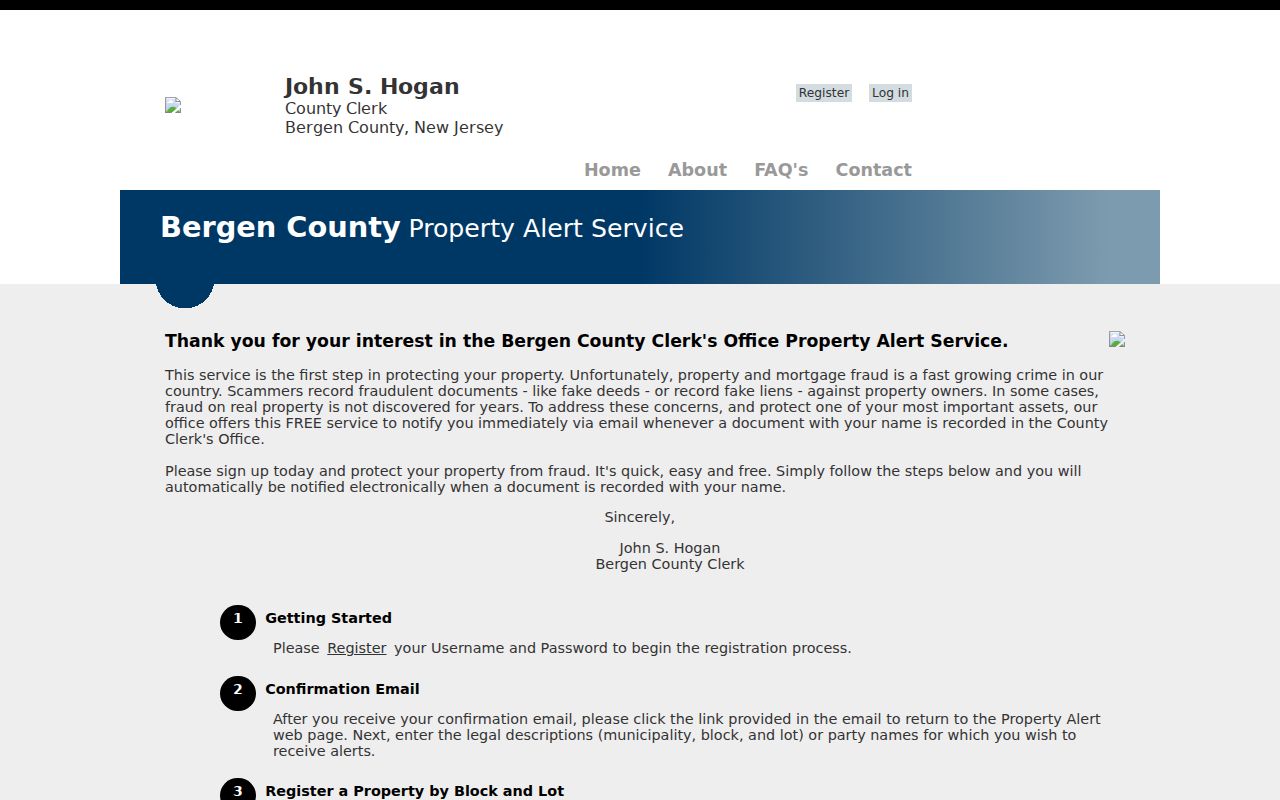
Registration connects an alert to a parcel or party search term, rather than creating a neighborhood directory.
Bergen Property Alert Name Variants
Property Alert's official instructions emphasize adding every plausible name variation, such as surname-first and middle-name variants. That is a useful Bergen search lesson: a matching parcel may still be missed when the recorded party name uses a different form. The alert reports a matching recorded document. It does not prevent fraud or establish that an alerted person occupies the property.
The Property Alert workflow and limitations describe the name-variant step and the service's fraud warning.
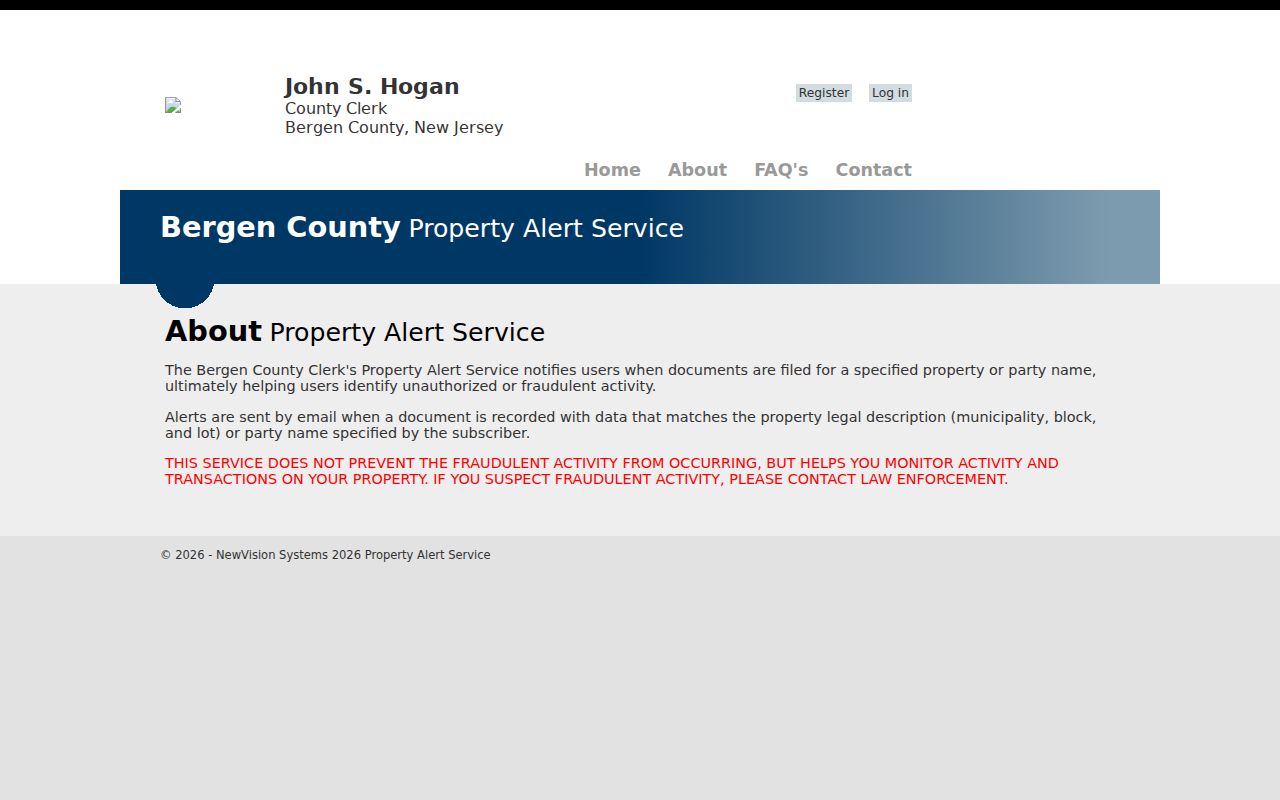
When an alert arrives, check the instrument, party role, municipality, parcel, and available image through the Clerk before relying on it.
Civic Leads for Bergen Neighbors
Public civic notices can point to organizations connected with a place without exposing private membership details. A 2026 Teaneck Independence Day notice names several community participants. These are organization leads for municipal notices, library clippings, or public event history, not evidence that an individual belongs to a group or lives on a particular block.
Coalition of Teaneck Neighborhood Associations
Named in Teaneck's official event notice. Use public municipal notices or the organization's own public contact route for current activity.
Northeast Teaneck Presidents Association
A named civic lead in the same official notice. No membership directory was verified or claimed.
League of Women Voters
Listed among civic participants in the event context. Treat a public event listing as a public-name lead only.
The Teaneck civic and neighborhood-association notice is the source for these public organization names.
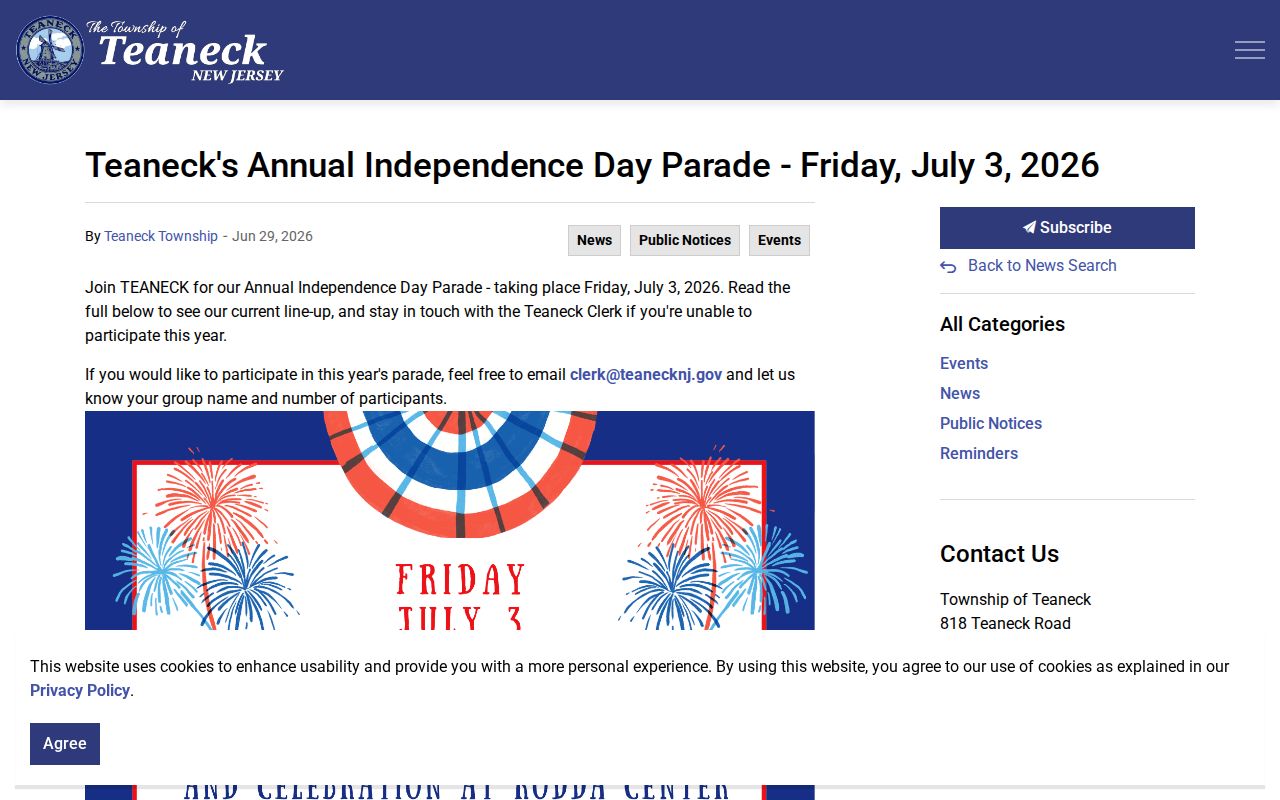
The notice documents civic participation, while private contact lists and membership details remain outside a block search.
Bergen Neighbors: Official or Commercial
Official records retain the purpose, date, and custodian that make a result interpretable. Commercial neighbor-lookup categories may collect older directories, marketing data, property fragments, or court snippets. They can be stale, merge same-name people, or omit the source date. Follow any lead back to the source that created the record.
| Official record route | Commercial lookup category |
|---|---|
| Names the custodian, record type, and date, with defined access limits. | May combine fragments without preserving the record's purpose or update date. |
| Supports a narrow question about a parcel, filing, election status, or historical listing. | Can suggest a lead, but cannot establish present occupancy or identity. |
| Allows a reader to check the underlying instrument, index, archive, or agency. | Requires source-by-source confirmation before it is relied upon. |
1861 Clues for Bergen Neighbors
The 1861 Bergen cadastral map is a rare historic block clue. It shows landowners' names, roads, buildings, householders, and Hackensack inset material with business directories. It can generate old street spellings and nearby landowner names to test against deeds, directory years, and municipal history.
Use the map as a dated historical source, not proof that a later household lived at the same place. The Library of Congress Sanborn record also identifies a Hackensack volume spanning 1926 to September 1950 with 56 sheets that include Hackensack, Teaneck, and Bogota. Its online image was not available in the inspected item, so request a library or Princeton copy rather than promising a direct scan.
Boundary changes also matter. Norwood formed from Harrington Township, Lyndhurst was previously Union Township, Wallington later transferred territory to Garfield, and Ridgewood had later annexations. Predecessor place names can be the missing term in an older block search.
Bergen Neighbor Voter Records Need Dates
New Jersey Voter Search is an official registration route, but its live lookup fields were not verified during the research. State guidance says the name must match the county record exactly, including hyphens, spaces, middle initials, and other spelling details. A missed match can therefore be a formatting problem, not a finding about a nearby address.
Bergen requires a written request for voter lists. Published charges include 25 cents per district for registered-voter lists. Preserve the list date and scope, and do not treat a campaign report, polling district, or older registration record as a current block roster.
Note: Election records can show dated civic status, but they do not confirm every person currently present at an address.
Privacy Limits for Bergen Neighbors
New Jersey OPRA starts with access to government records but includes exemptions, and many records have separate privacy rules. Daniel's Law limits disclosure of protected officials' home-address information. The New Jersey Address Confidentiality Program provides eligible participants a legal substitute address. NJGIN also warns that Daniel's Law can redact protected owner names from hosted parcel and tax-list data.
Do not seek or republish protected home addresses, personal identifying numbers, financial details, confidential election identifiers, adoption information, or restricted court material. If a record raises a safety concern, use an agency or victim-service route instead of contacting the person named in it.
Lawful use. Use Bergen neighbor records only for narrow, lawful personal research. Do not use them to monitor, stalk, threaten, intimidate, harass, or expose a protected person.